Kenya Water Pipeline
Project Overview
Maai Mahiu is a semi-arid region in Kenya’s Rift Valley. Groundwater there is heavily mineralized — high in fluoride and other dissolved solids — and seasonal rivers often run dry.
Several years ago, leaders from three villages near Maai Mahiu, Kenya approached Naomi’s Village with a simple request:
“Can you help us bring clean water to our communities?”
As a result, families either purchase expensive vendor water or women and children walk long distances — often two to four hours each day to collect it.
Rotary became involved after learning that the community had identified a reliable highland water source capable of serving over 12,000 people.
Rotary became involved after learning that the community had identified a reliable highland water source capable of serving over 12,000 people.
In October 2025, members of our Cross Timbers Rotary club traveled to Kenya to assess the viability of a gravity-fed pipeline from that source down to the valley communities.
What we confirmed was this:
- The need is real.
- The water source is viable, and
- Strong Rotary leadership is in place locally.
We are now partnering with the Rotary Clubs of Naivasha and Nakuru, both experienced Global Grant clubs, to help design and implement this infrastructure project.
This is not a short-term well project; it is a viable, engineered, Rotary-led solution to bring sustainable water access to more than 12,000 people. You can hear directly from leaders in Maai Mahiu about this effort.
Structural Challenges to Water Access in Maai Mahiu
Maai Mahiu sits in Kenya’s Great Rift Valley — a semi-arid region where rainfall is inconsistent and rivers are seasonal.
Groundwater in this area is heavily mineralized due to geothermal activity, with high levels of fluoride and other dissolved solids. In many cases, it is not usable without costly treatment.
Groundwater in this area is heavily mineralized due to geothermal activity, with high levels of fluoride and other dissolved solids. In many cases, it is not usable without costly treatment.
Unlike larger cities, there is no reliable municipal water system serving these villages. So this isn’t simply about drilling another well.
It’s a structural water access challenge.
That’s why a gravity-fed pipeline from a reliable highland spring becomes such a practical and sustainable solution.
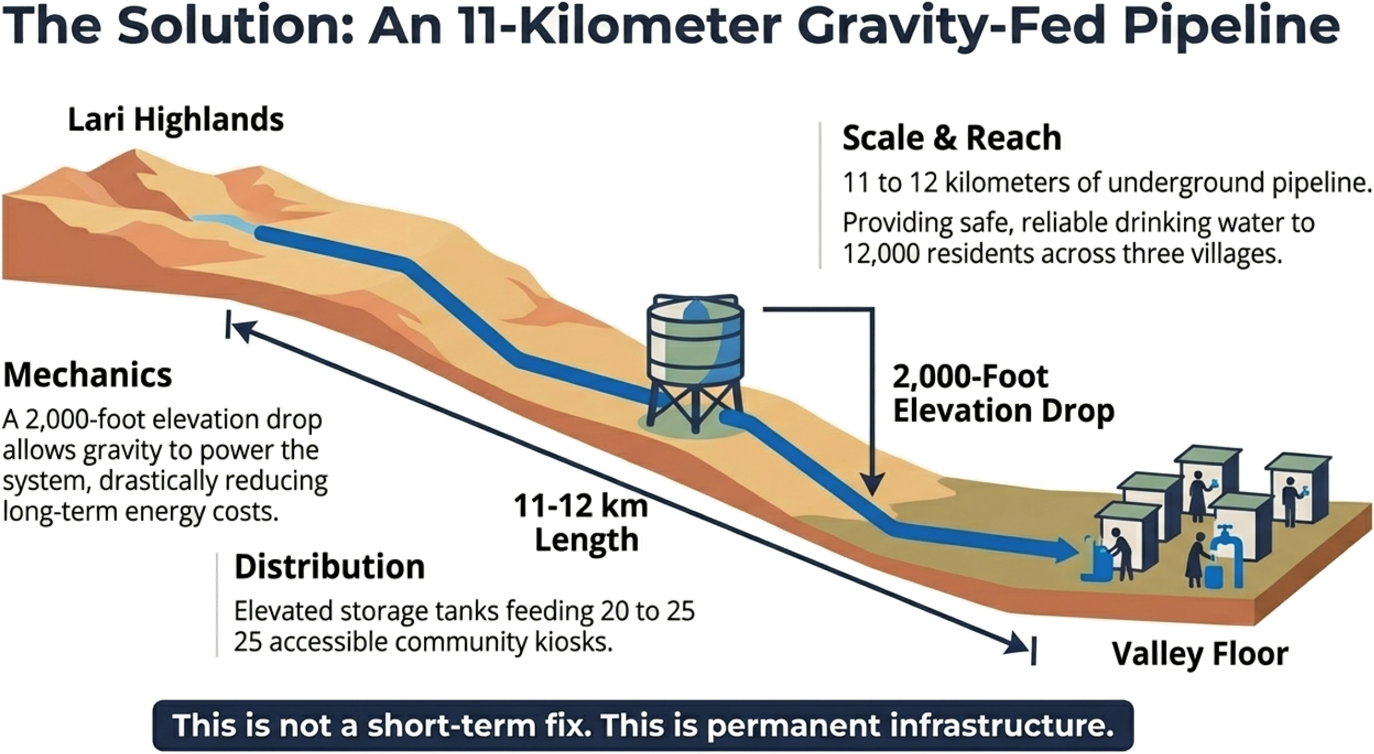
For more details on this project, please look at the Muruka Project Presentation link in the left pane.